We learn to live in lack
We convince ourselves that more is better
We forget to realize that more will never be enough
We run in circles tirelessly searching for something that we can never truly find
We leave behind the child that could be amazed by a single blade of grass
We're taught to "accept reality"
We adopt an an autopilot way of life
We do so much because we feel "we have to"
We jump from one thing to the next, one conclusion to another
We pretend to know
We almost never pause
We almost never question
We almost never stop to think for ourselves
We almost never honestly ask "why?"
The Self Prisoner
At times, it just feels like a battle. I fight and withstand what later appears to be nothing but the making of my own hands. There’s warfare in my mind, making my whole world go blind. I detest the words that serve no purpose, yet allow the reoccurrence to form again like a current. I don’t fear what’s out there, for I’m aware of what’s in here. I fret neither ridicule of others nor the rejection of peers. The only house I must feel safe in is that of my own. There is nothing more frightening than being lost in your own home.
The Cultivation of Awareness as a Gateway to Freedom
For as long as I can remember, there has been a peculiar utterance that I could only discern as being in the back of my mind. For most of my childhood and adolescence, it took a backseat, observing all I did. I by no means associated myself with it, but to some degree it was quite comforting. I acted and lived as I did, and at the time; I would not have been able to point to this distant spectator with any amount of certainty. In psychological terms, this was happening at a subconscious and even unconscious level. During this period, I was a kid, living, exploring and walking the paved path that seemed to be all there was. Sure, I had freedom to wander and find passions, such as basketball, which became my primary focus, and yet; even with a seemingly boundless landscape, at least from my narrow perspective, there was still a conventional way of life, that as years passed by, appeared to be enclosing on me. I find the comparison of a chess game to be fitting, that the only moves you can make are those within the rules of the game.
Although, as my awareness heightened and my gut feeling began to tell me otherwise, I realized the chess game was all in my mind, that I only played with these rules if I believed these rules governed my life. Now, this articulation and understanding did not occur as quickly as it sounds, but rather the initial process of the expansion of my intuition and awareness began when; I behaved and made decisions in a manner that facilitated those in positions of authority to judge and voice “their” opinions. I would say that the increasing external pressures and stressors in both strength and volume served as a catalyst for the observer of my mind to now take on an active role in my life. To be blunt, I was not an exemplary student and my efforts towards changing that, for the most part, were subpar. I had academic potential that I had no business fulfilling because the “peculiar utterance” or my conscience had other non-specified plans. It was the repeated unsatisfactory grades, along with the comparing and competing aspect that the schooling system inevitably injected into the majority of students and even their parents that just did not jive well with me. I was being thrown into an ideological framework with the notion that if I did not adhere to it that “success” would be unattainable or highly unlikely and that I could not be properly educated. Now you might be asking why I’m sharing all of this, and my answer would be that if it were not for the cultivation of my awareness, my authentic self and intuition would be latent and unexplored. Granted, I was fortunate to have an ample amount of freedom to gather all these insights and stray away from the crowd in order to develop as a unique individual.
Well then, you might ask, what happens to those who are not able to break free of this mechanistic way of life. The result of this it seems is that, in referring back to the chess game analogy, they would live and develop within the confines of the game, only making permitted moves, with the illusion of freewill. Much of what I observed were those who aimed to excel for the praise and approval of others, obtaining a sense of security; they would work tirelessly for a number or letter on a piece of paper, oblivious to exactly why they did so, but always being led to what was next without pausing to to think if that next step was really theirs. From my viewpoint, it seemed as though, the approaches and the world most saw were simply adopted; susceptible children were being thrown into a predetermined complex structure without a clue of what this all meant to them. This acts as an inhibitor to freely venture and develop a sense of self, all due to the continuous input that is labeled education. With this said, there is no right or wrong course of action; this is neither a moral or ethical matter, but as Carl Jung writes, “The privilege of a lifetime is to become who you truly are.”
With this in mind, you can no doubt live a comfortable life without thought of the ideas I am expressing, but I ask, is comfort and pleasure all you seek? When you close your eyes and let your imagination run wild, what do you see? If you were to pause for a moment, could you explain why you’re walking in a certain direction in life and does it feel authentic? Who were you before the world fastened in on you, molding you according to the image that society feels suitable. Have you lost touch with your childlike self, the creative you, wandering in awe at this miraculous universe, questioning all and everything with a keen curiosity, eager to explore. It is the very essence of awareness that even allows for this sort of probing and analysis, which can give rise to grand realizations that can lead you to return to a deeper and more connected self. The cultivation of awareness is particularly imperative and valuable to those who have lost that awareness, while consumed and distracted in their busy lives. In fact, this is quite common and many would require a spark to ignite that internal awareness, to possibly breach these patterns. That being said, if given thought, time and true reflection, it should be apparent where you stand in this matter.
As far as my personal life goes, after I graduated high school, I passively decided that I would make my way to college, in spite of the fact that; I was fairly skeptical and uncertain about this process and environment panning out for me. In particular, I was pleased about meeting my advisor, who was also the renowned psychology professor that had spoken at the open house and from which I became increasingly fascinated by. He spoke about death, our awareness of it and the thoughts and behaviors that resulted from this acknowledgement of the inescapable, in either a positive or negative course. We had some engaging conversations, in which I shared ideas from my dubious thoughts about this educational system and the psychological effects I feel it can have on individuals in their developmental years to more fundamental aspects of the nature of our existence. Point being, in my experience, Sheldon Solomon is a distinctive individual and a breath of fresh air. I mention this because when I met with him as the first semester came to a close, I expressed that I would be leaving college to freely explore life in the broader context of our universe with an intent of attaining meaning, while plunging into the question of, “who am I?” He didn’t seem taken aback by this, and was reassured when I made it clear that I would not be sitting around twiddling my thumbs. Ultimately, it was the cultivation of awareness that allowed my intuitive mind to guide me to a decision that may have not appeared to be rational on the surface level but that clicked in the depths of my being.
And so, I cannot understate the value and effect awareness has and will continue to provide as a pillar in my life, while serving as an agent for change in a growth-conscious manner. Continually, by broadening the scope of my outlook, I have expanded my internal terrain, liberating my relative experience to a more unified field. To be direct, I feel freewill is as real as you perceive it, but don’t be deceived, for as Sadhguru says, “Without the necessary awareness, freedom is dangerous.” To conclude, whether dealing with the trivial or in search of a greater understanding, awareness is the light that no matter how small the room, it cannot be seen without the spark that shines from within.
Advertisements
Reactivity: A Symptom of The Overactive Ego
Right off the bat, I’m going to contradict the premise of my own title, by stating; there are primitive and instinctive reactions that are innate to our being. Meaning, this form of reactivity is certainly not a symptom of the overactive ego, but rather a response to our environment as a means of survival. As you might of gathered, this will be a compositional analysis of the idea of “reaction.” With that said, you may have had a particular reaction or skepticism towards the opening sentence, as it is contradictory to the title. My explanation is that the title was spontaneous and I am here to explore it, after all; the name of this blog is Infinite Seeking.
As a basic definition, reaction is the action or expression that follows a happening. For example, if a person were to say something that you feel is rude, you may react either verbally or physically (or not at all). In this case, what is said is the “happening” and what follows is the “reaction.” The questions I then pose are, does a happening always necessitate a reaction? Do we often react in a positive or negative manner? Does the reaction serve or harm our well-being? Is the reaction to validate or add to a point made? Is the reaction to get even with the opposer? Is the reaction to be right or prove a point, to be in a position of superiority? If none of the above, then why do we react? Have we simply become accustom to reacting no matter the type of happening, in a habitual and subconscious fashion? All these are questions that I contemplate in order to bring awareness to why I react, to possibly delay an unhelpful and unwarranted response.
Continually, how do we reach the point of reaction? I would say it is through the processing of a happening that we come to interpret how we will move forward. So then, is the processing an automatic or manual function? Is it something that is initiated consciously or subconsciously? In my personal experience, I’ve found that the more emotionally attached I am to something the more likely I am to react automatically and without thought. For example, initially when I dropped out of college, there were certainly moments where I reacted from a place of defensiveness, caused by an attachment to a decision I felt others did not understand, and as a whole; this perspective gave rise to a particular emotional response. With that said, in the book, Thinking Fast and Slow, Daniel Kahneman speaks about two ways in which we think: System 1 and System 2. System 1 would be your automatic thinking-response, where as; System 2 would be a more thorough and processed method of thinking-response. In terms of reaction, it seems our System 1 usually gets the best of us. It is common for a reaction to precede the thought of why we did so. And, typically there is a correlation between the emotional strength and quickness in which we respond. Our rational mind cannot be present when we are emotional and vice versa. But then, how do we know if we are being emotional or rational? I would say, it is by being presently observant that we can bring awareness to why we do what we do.
Now, where does this idea of reactivity being a symptom of the overactive ego come into play? Well to start, I will address the concept of the ego. Simply put, the ego is “you.” It is the identity and personality in which we all know ourselves by; the way we interact and perceive each others is all through this idea of “I” of “me.” Eric Abrons is a humanistic construct and abstraction of the natural world, a conceptual extension of the physical body. These identities serve as a way for our societies to function the way they do; they facilitate the ability for people to “understand” who you are, in a world run by postulated notions and social constructs. I put understand in quotations because to reach a point of complete self- understanding is unattainable, and so to find that in another person is absurd. This is another symptom of the ego, the thought of figuring people or things out. Ultimately, the ego will exercise its power over your mind as a means of control, to keep in place its idea of the surrounding world.
The ego, however, is not who you really are. The ego is your self-image; it is your social mask; it is the role you are playing. Your social mask thrives on approval. It wants control, and is sustained by power, because it lives in fear.
Deepak Chopra
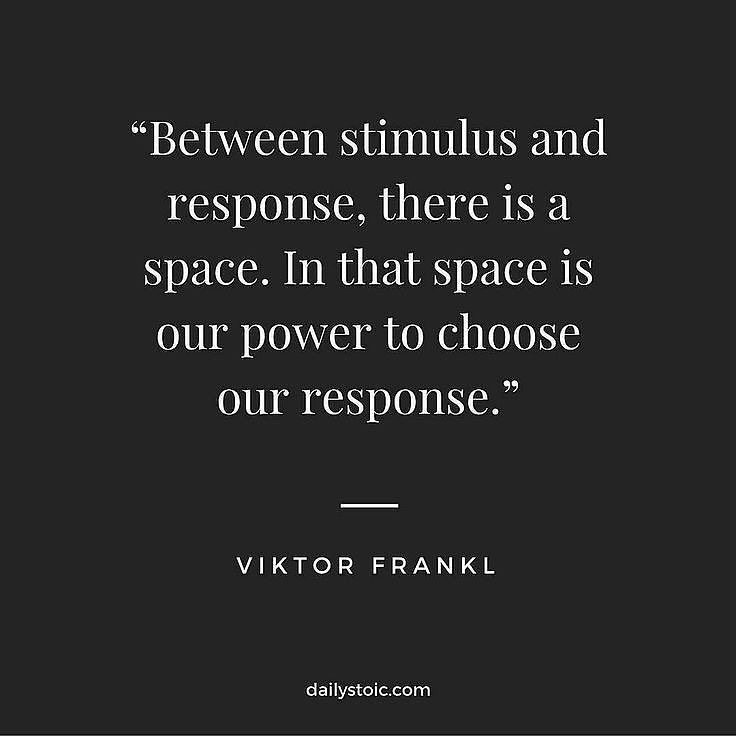
To come full circle, I feel it would be fitting to propose a healthy approach towards this reaction dilemma. As mentioned before, reaction is the result of the ego processing and interpreting a happening. Therefore, if there can be a delay between the happening and processing then the reaction can be avoided by virtue of being observant. This way, the awareness of the situation at hand will lead to a conscious choice, which will inhibit the automatic response. By doing this, you are transcending the grip of the ego and acting in the moment as an authentic human being. Eckhart Tolle expresses that, “non reaction to the ego in others is one of the most effective ways not only of going beyond ego in yourself but also of dissolving the collective human ego.” Ironically, it seems the most effective way to go about reacting is to merely not react, as a service to your own well-being, but also to others who are indirectly effected by your ability to withdraw from the control of the ego. In conclusion, be vigilant of your mind and its thoughts; be observant of your behavioral patterns, and when in doubt; delay the response.
Advertisements
The Unwavering Mind
Whether I think thoughts
or thoughts arise,
I can't help but deny
the premise
that they are mine.

And in the blink of an eye,
We live and we die.

With this idea
of time,
We become lost
in our minds,
Lost in this idea of "I."
Advertisements
Gratitude: A Pillar of Well-Being
Whether we realize it or not, gratitude being our backbone, is the underlying feeling of our highest, most ecstatic experiences. In moments of undeniable and indescribable aliveness there is a rush of gratefulness that is dispersed into the aura of our being. This energetic force becomes one that is contagious and can be felt as well as transmuted to those present. When we love and laugh or celebrate and look back, there is an intense and rhapsodic sensation for all that is. There is an essence of connectedness and unification that is fused into moments of gratitude or rather just a feeling of oneness. As far as I can discern, to be grateful is be in a state of present appreciation for both the simple, intricate, as well as light and dark nature of this miraculous happening that we call life. Furthermore, a binary example of this is expressed by Einstein as he states, “There are only two ways to live your life. One is as though nothing is a miracle. The other is as though everything is a miracle.”
It seems the more aware we become of who we truly are the more grateful we become. Any intrinsic energy instantly grows stronger the more attention and focus we bring to it. It seems the primary reason for the lack of gratitude in most stems from compulsive thinking of the trivial, superficial, as well as an absence of awareness and appreciation for life as a whole. Without perspective one cannot blossom. Perspective allows for free-flowing and natural growth. It gives rise to ones authentic form, in which rigidness cannot exist. Yet, we tend to focus on that which is front of us and not what is foundational to us. It is this approach that breeds a pathological cycle of incompleteness and an external search for our figurative “missing pieces.” All of which accounts for the the feelings of not having or being “enough.” Furthermore, a shift of focus and energy is all that is necessary to facilitate a new perspective which then can generate a greater awareness over our wholesome being, producing an abundance of gratitude. Our lens is our life and like any other emotion, feeling or state of being, the more you focus on it and think about it the stronger it becomes.
“Acknowledging the good that you already have in your life is the foundation for all abundance”
Eckart Tolle
Well-being in many ways can be defined as the ability to be aware of the light in life, but at the same being able to acknowledge the light in dark or rather just the beauty of it all. When faced with adversity or a seemingly dreadful moment, the way one sees and maneuvers it speaks volumes to ones capacity to look past the surface level and to recognize the inner-magnificence that lies within each experience. Rejection can lead to resurrection; hurt can lead to hope and loss can lead to love. All this is within reach by simply being grateful for everything no matter how it may seem at first sight. To accept and embrace the absurd happenings of life and to flow with the moment and not against it. It is not about looking for something particular, but instead understanding the wondrous nature of the experience itself and fully surrendering to whatever it may bring. To not see life as something that is happening to you, but rather to see it as something that is happening for you. As challenging as it may be sometimes, it seems that is what makes it all worthwhile, the uphill battle that is a seemingly endless journey, and yet to take each step with a sliver of gratitude.
“The only thing that could be bad is to take it seriously”
Alan Watts
In the end, whatever that means, it is within each of our hands to live pleasantly or not, to take things too seriously or not and to live gratefully or not. When we wake up first thing in the morning, do we look to rejoice in the day or to the aching that lies at bay. Do we breathe with a grace like the sweeping leaves of trees or do we fall victim to reacting to technology as though it is a need. When the day darkens and the rain drops fall, do we dance and flow with it or do we complain and persist against it. With every rise and fall there is only one thing that remains through it all, and that is the way you see things and what you choose to believe.
Advertisements
Wholeness: The Way of Being
Just as every other organism in this universe, we human beings are also whole. I would simply define the idea of “wholeness” as lacking nothing, to be in a state of completeness and acceptance. Although fortunately for all other species, they are not capable of experiencing a way of being outside of their instinctive and pure form, being one that is whole. On the other hand, human beings possess a level of consciousness which facilitates the ability to escape our wholesome nature, and to wander into a world of creation, one in which we are convinced that wholeness must be reached externally. This is a world run by ego, rather than being, a world that builds on a given identity or better known as personality. It is in this world that, we have created constructs such as time, one of many systems that helps to alleviate the sense of uncertainty, allowing humans to have a framework of understanding. I say all this to assert that the primary reason that humans feel a lack of wholeness is due to a lack of awareness of our naturalistic being. It is our relentless need for identification and the development of ego that imprisons us in a world that cannot truly attain wholeness, but only experience glimpses.
“The Art of Being: A state of wholeness in which the mind functions freely and easily, without the sensation of a second mind or ego standing over it with a club”
Alan Watts
These fleeting moments of being, can be most accurately described by what Abraham Maslow referred to as “Peak Experiences.” It is in these moments that, there is a total absorption of the happening, transcending the ego and all constructs of “reality.” One of the best examples is observed in love, where the ecstasy of the moment seems to plunge the lovers into a realm beyond space and time, an experience that is complete and immersive. Now, I would say that a peak experience such as love is a higher form example, given that it is a synergistic force. A more common form could simply be taking a walk or being in nature in which you are enthralled by the moment to the degree that the feeling of wholeness is reached, a point where the mind is no longer active. This is to say, wholeness is a function of internal acknowledgment of the ubiquitous happening. Meaning, no matter the good or bad, light or dark, wholeness is an art of constant acceptance and embracing of the now, regardless of the particular feeling.
“Wholeness is not achieved by cutting off a portion of one’s being, but by integration of the contraries”
Carl Jung
This seems to be one of the more challenging facets of living in a holistic manner, to recognize and implement those hidden areas of our being that we tend to push away. There are distinct characteristics that many would say are “evil” or that represent the darkness within, which most do not want to embody or identify with. Moreover, they are resisting what it means to be whole. It is common to mistake the integration of these dark elements of our being with the execution of them, but rather; I would say it is the relationship and acceptance of them that establishes a connection as well as control. Carl Jung often referred to this dimension of the psyche as “the shadow.” He writes, “Everyone carries a shadow, and the less it is embodied in the individual’s conscious life, the blacker and denser it is.” With this said, it is in our best interest as whole human beings to acknowledge those thoughts and areas of our mind that we tend to reject, in order to move in the direction of health and well-being.
“The wholeness and freedom we seek is our true nature, who we really are”
Jack Kornfield
In conclusion, what I have found to be most valuable and insightful is the realization that all we seek can be found in the depths of our being, that; all power lies in the individuals ability to look within, to connect and to adhere to ones uniqueness. It is in the acceptance of all the characteristics of our being that we can live holistically and find tranquility outside of the bounds of culture and society. There can be a balance of ego and being in which one can still navigate the social world and interact within it without being consumed by it. This oneness we are searching for is nothing but the awareness of it; it can not be actively pursued, but rather consciously observed in the abundance of presence. Our nature is far more simplistic than we make it out to be. It is an experience and so to live it authentically we must embrace it fully. There is no effort or striving that is necessary to be in the moment. The way of being is nothing more than the acceptance of all the arbitrary happenings, to be detached yet connected, this is wholeness.
Advertisements
Change: The Inevitable Life Force
At times we expect it and so we accept it, while when we can’t see it coming we tend to reject it, that “it” being change of course. Whether we make conscious decisions to change within or not, the change that occurs outside of us is undoubtably happening. In its passive form, change is unavoidable with time; It is rooted in the natural journey of life.
“The universe is change, our life is what our thoughts make it.”
Marcus Aurelius
In contrast, each of us possess the consciousness to initiate change and to bring potentialities into reality. When we can move with the natural energy of change, we can conduct it in a way that serves the trajectory of our being. This calls for continual acceptance of the present, in order to transmute thoughts into actuality, cultivating the future moment by moment. The cards for change are at our fingertips, but so often we lose sight of our current choices, looking back at what has already transpired.
“The secret of change is to focus all of your energy, not on fighting on the old, but on building the new.”
Socrates
Change is aligned with the flow of time, meaning to fight change is to fight life. The less energy spent on resisting what is, the more energy you will have to cultivate your capacities, in the conscious manner of change. Now, of course there are emotional difficulties of our past that can make the future foggy, but it is not the future to worry about, it is the present. I say this because, what occurs in the present will determine the future and so if your attention is placed on the past, it will show up in your future. The mind can serve you or destroy, depending on the relationship you have with it, meaning are you in control or is it? It will repeat what it has done in a compulsive cycle, unless conscious change is made.
“If you always do what you always did, you will always get what you always got.”
Albert Einstein
But ultimately, the first step to change is acceptance as Carl Rogers brilliantly put it, “The curious paradox is that when I accept myself just as I am, then I can change.” It seems when you can embrace each moment as it is, the universe then opens up to you, with a receptiveness to intuition and the blossoming of your thoughts. The more open you are to change the more open the existing energies will be towards serving your well-being. Openness is a fundamental quality, intertwined with change and working in favor of those who are aware of its power. Change is dynamic and unpredictable, therefore; it is best handled with high levels of acceptance and openness.
Embrace the unpredictable and unexpected. It is the path to the infinitely creative in you.”
Deepak Chopra

Equally important, there is something uniquely beautiful about not only being aware of the many changes in life, but in appreciating the evolution of nature that surrounds us. Whether it be the day by day change of the sun rising and setting, or the leaves on trees changing season by season, it is those somewhat subtle changes that also change us. The amount of light we receive from the sun, the drop or rise of temperature, the color and texture of nature, we are unified with the surrounding environment and simultaneously changing with it. For every drop of rain and every bad day, no matter what we do or say, there will forever be change.
Advertisements
A Step Into Existence
I have come to the awareness that I exist, that I am aware over my own consciousness as well as this ever-present experience. I state this to simply say as Descartes put so eloquently, “I think, therefore I am,” which is fitting to suggest that an individuals awareness of life validates existence in itself. So, I exist, but what is this “I” and is it the “I” that exists or the awareness of it? I would say that the awareness (consciousness) is what exists and the “I” is rather the identity, illusory in some sense.

The identity is better known as the ego or the persona, an image that is attached to the person as a means of interaction and individuating oneself in this world. Alan Watts explained that, “Ego is a social institution with no physical reality. The ego is simply your symbol of yourself.” It is a way for people to “know” you and for you to “know” them. The ego is the central point of consciousness, as Carl Jung would say, in which we experience thoughts and emotions, creating the memory that forms each of us; it is responsible for the five senses of this perception.
Now, the reason for my calling it “illusory” is because our true nature as beings exists without an ego. In moments of true presence, whether that be love, playing a sport or fully doing whatever you are doing, in these times, the world seems to fade away because that “world” is a limited reality. It is in these moments that, we are detached from ego, leaving only the breath of the present and what is happening here and now. These are what Abraham Maslow referred to as “peak-experiences,” where there is only bliss and the purity of the happening. His words were, “Expression and communication in the peak-experiences tend often to become poetic, mythical and rhapsodic, as if this were the natural kind of language to express such states of being.” It seems that the energy in these moments are truer to our nature, with a higher sense of connectedness to being. I believe this is because, in those heightened experiences, there is an expanding of consciousness, in which we are no longer bounded by the ego.
With this in mind, what is experienced in this uninhibited consciousness and where has the life of the ego gone? The ego is always there, just as consciousness is, which means perception is a matter of awareness and what you are concentrated on at each moment. Alan Watts put it simply, “The ego is nothing other than the focus of conscious attention.” This thought is in direct alignment with the “peak-experiences” and moments where there is a shift of attention, whether that be intentionally or not. Given the elevated emotions and feelings of wholeness in this ego-less state, I would postulate that the conscious experience is a greater experience, where limitless possibilities are abundant by nature. Furthermore, there is increased presence, a unification with nature and ultimately a connection to our untouched form as spiritual beings. It is in this realm of consciousness where life is led inside-out, instead of the opposite.
When there is an awareness of consciousness and the role of the ego, life becomes effortless in being and rewarding in seeking; To seek within for greater awareness and understanding with no means to an end, but simply for the exploration of life. The authentic self lies in the awareness beneath the ego, in the depths of being, the soul. Carl Jung remarks, “who looks outside, dreams; who looks inside awakes.” When this process of uncovering the deeper self begins, so does life, as living from within. To accept and live courageously in this manner is to truly step into existence.
Advertisements
The Journey Begins
Thanks for joining me!
Good company in a journey makes the way seem shorter. — Izaak Walton

Advertisements
 Infinite Seeking